Water seems simple, but industrial water is never just H₂O.
Depending on the source — mains supply, bore water, desalination, or river water — it will contain dissolved minerals, salts, oxygen, organic matter and other impurities.
If left unmanaged, these contaminants create problems that affect system reliability, efficiency, and safety.
There are four major issues water can cause:
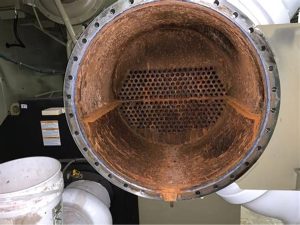
- Corrosion – gradual metal loss due to chemical or electrochemical attack.
This weakens pipework, heat exchangers, condenser tubes and cooling tower structure.
- Scaling – mineral deposits forming on heat transfer surfaces.
This reduces heat transfer efficiency and increases energy usage.

- Biological Growth – bacteria, algae, and fungi colonising wetted surfaces.
This can lead to Legionella risk and biofilm that insulates heat surfaces.
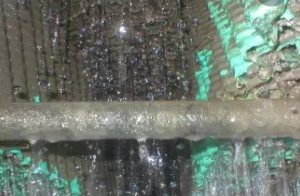
- Fouling – accumulation of sludge, rust, sand, silt, and debris.
This blocks pipes, reduces flow, and increases pump load and wear.
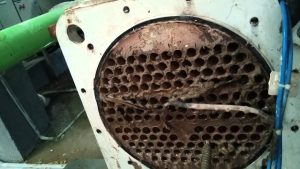
When these issues are present — especially in combination — the result is:
- Reduced plant efficiency and higher running costs
- Shortened equipment lifespan
- Increased maintenance and unplanned downtime
- Potential health and safety risks
- Failure to meet local government regulatory requirements
All water sources behave differently. One may be more corrosive, while another may present higher scaling or biological risk.
This is why water treatment must be site-specific—not generic.
—
- The Six Core Objectives of Water Treatment
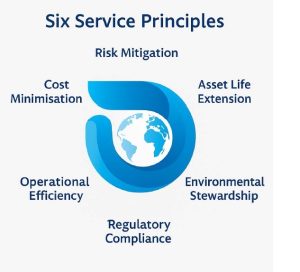
A professional water treatment program should achieve the following:
- Compliance
Ensure the site meets all regulatory standards and internal quality assurance requirements.
Failure to comply can result in legal, financial, and operational consequences.
- Risk Reduction
Minimise the risks and liabilities associated with heating, cooling, storing, and circulating water within the plant.
- Cost Control
Apply a treatment approach that delivers the required protection without unnecessary chemical or service costs.
- Plant Life Extension
Reduce corrosion, fouling and scaling to maximise equipment lifespan and minimise unplanned downtime.
- Efficiency Optimisation
Ensure the plant operates at maximum thermal and hydraulic efficiency.
Even small efficiency improvements can result in significant energy and water savings.
- Environmental Responsibility
Select and apply treatment solutions that minimise environmental impact while maintaining performance.
Sustainability should be reflected not only in the chemical program, but across all operational practices.