Course Content
Welcome & Instructions
This course provides foundational knowledge of industrial water treatment systems, associated risks, and Australian compliance obligations. It is designed for personnel working with cooling towers, closed loops, boilers, filtration systems, and chemical dosing equipment.
0/1
Module 1 – Water and Water Treatment
This module covers the issues that water can cause in water systems, and why water treatment programs are employed
0/2
Module 2 – Closed Loop Systems
This module covers closed loops and associated water treatment programs
0/2
Module 3 – Cooling Water Systems
This module covers cooling water systems and their associated cooling towers
0/2
Module 4 – Filtration in Cooling Tower Systems
This module is aimed at identifying the need for filtration, and the various types used.
0/2
Module 5 – Legionella and Control Strategies
This module describes how legionella poses a risk in cooling water systems and how to reduce the risks associated with it.
0/2
Module 7 – Dosing Equipment
This module describes the dosing equipment used in cooling tower water treatment.
0/2
Module 8 – Legislation and Compliance
This module is to expand on the legislation surrounding cooling towers, and people's obligations to maintain compliance.
0/2
Private: Water Treatment Fundamentals and Compliance


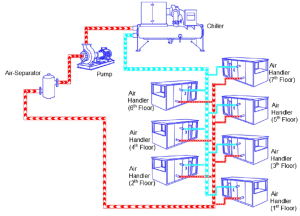
A closed loop is a sealed circuit of water that circulates continuously without evaporation and is not exposed to the atmosphere.

Closed loops are commonly used to distribute chilled or heating water throughout buildings, or as condenser loops transferring heat between systems.
 

The two main risks in closed loops are corrosion and fouling.

If left untreated, the metals within the system will gradually corrode. The corrosion products formed will settle in low flow areas and on heat transfer surfaces, causing blockages, reduced heat transfer, increased pump load, and eventual equipment damage.

To prevent this, a closed-loop specific corrosion and scale inhibitor is added. This treatment adjusts the pH into the optimal range for the system metals and forms a protective film to prevent oxidation. Common inhibitors include sodium nitrite and azole compounds (such as tolyltriazole), which protect steel, copper, and other system metals.

The selection of an appropriate corrosion inhibitor program is critical when aluminium boilers or aluminium heat exchangers are present in a system. Aluminium is significantly more sensitive to water chemistry than traditional steel or copper alloys and can be rapidly damaged if unsuitable treatment programs are used.
 
Many conventional inhibitor programs, particularly those designed for mild steel systems, operate at higher alkalinity levels or contain chemical components that are incompatible with aluminium. Elevated pH, high hydroxide concentrations, and certain inhibitor chemistries can cause pitting, oxide layer breakdown, and accelerated corrosion of aluminium surfaces.
 
For this reason, aluminium boiler systems require carefully controlled pH ranges and inhibitor formulations specifically designed to provide protection without attacking the aluminium substrate. Failure to select a compatible inhibitor program can lead to premature equipment failure, loss of heat transfer efficiency, warranty issues, and costly system repairs.
 
Correct inhibitor selection, combined with proper system cleaning, oxygen control, and ongoing monitoring, is essential to ensure long-term reliability and safe operation of aluminium boiler systems.


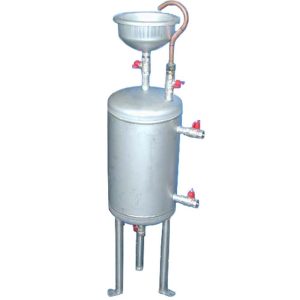
These inhibitors are typically introduced into the system using a by-pass pot feeder, which allows safe chemical dosing without significant water loss.
 

Once dosed, the system must be periodically tested to ensure inhibitor levels remain within the required range.

Closed loops may require re-dosing for the following reasons:

  1. Water Losses

If a closed loop loses water, it is topped up with fresh mains water which contains no corrosion inhibitor.

This dilutes the system and reduces protection.

The system should be checked for leaks, repaired where necessary, then re-dosed to restore inhibitor concentration.


  1. Bacterial Activity (Nitrite-Reducing Bacteria)

Certain bacteria can convert sodium nitrite into sodium nitrate, which provides no corrosion protection.

This results in rapid corrosion if untreated.

If detected during routine testing, the loop must be dosed with a biocide to eliminate the bacteria, then re-dosed with corrosion inhibitor to restore protection.


 Summary – Closed Loop Systems
 
This module has outlined how closed loop systems operate and why corrosion control remains critical despite the system being sealed. We examined the key causes of corrosion, including oxygen ingress, poor water chemistry, microbial activity, and mixed-metal construction.
 
The importance of selecting a suitable corrosion inhibitor program—particularly where aluminium components are present—was highlighted, along with the need for regular testing and monitoring. Effective closed loop management protects equipment, maintains efficiency, and extends plant life.