
Cooling tower water treatment requires the correct application of corrosion inhibitors, scale inhibitors, and biocides. To ensure these chemicals are added accurately and consistently, a dosing system is used.
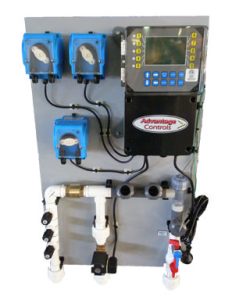
A dosing system helps maintain stable water chemistry, optimize system performance, and meet regulatory requirements for microbial control.
An automatic dosing unit used in cooling tower systems includes:
- Chemical dosing pumps
- Chemical storage bunding
- TDS (Conductivity) controllers and bleed valve
- Biocide timers
- Injection points and distribution tubing
- Safety equipment and spill containment
A properly configured and maintained dosing system allows treatment chemicals to be added automatically, safely, and at controlled rates.
Chemical Dosing Pumps
A chemical dosing pump injects a measured amount of chemical into the cooling tower return, basin, or make-up line.
These are usually diaphragm metering pumps, or Peristaltic pumps because they provide accurate and adjustable dosing.
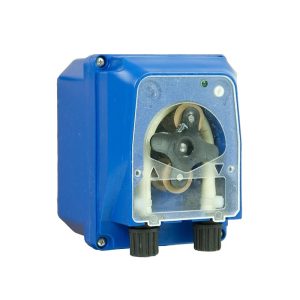
Typical maintenance requirements for pumps include:
- Inspect pump tubing and fittings for leaks
- Replace pump head diaphragms and check valves as required
- Confirm pump dosing rate during service visits
Chemical Bunding Tanks
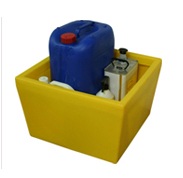
Chemical bunds are used to store treatment chemicals safely on site, and should meet certain requirements such as:
- Bunds should be in a position to catch leaks and spills
- Bunds must be clearly labelled
- Safe access must be provided for refilling chemicals contained in the bunds
- Bunds must have a volume of 150% of the chemical drum capacity
- Should be made from materials that are compatible
Conductivity Control and Bleed
As water evaporates in cooling towers, dissolved solids become concentrated.
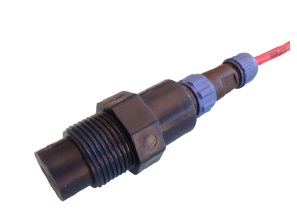
A conductivity controller continuously measures the water total dissolved solids (TDS) and opens an automated bleed valve when levels are too high. Due to the water loss from the bleed, the cooling tower will start to bring in more mains water, thereby reducing the TDS levels.
This prevents scale formation by maintaining cycles of concentration.
The TDS probe must be cleaned and calibrated during service visits for accurate operation.
Biocide Dosing
Biocides are used to control microbiological growth, including Legionella.
Biocides can be either liquids, or in tablet form.
Liquid biocides are typically dosed via frequency and duration timers, or via ORP control.
Bromine and chlorine tablets are dosed via an ORP probe, and use water flow from a pump to enter the tablet container, where it dissolves the tablets and returns it to the cooling tower basin.
During routine maintenance the following should be undertaken:
- Timers must be checked to ensure correct day and time settings and correct dose duration
- Pumps are primed and functioning
- ORP probes are clean and calibrated
Injection Points and Distribution Tubing
Chemicals must be injected into points of good circulation, typically the tower return line or basin recirculation loop.
Chemical injection nozzles are used to:
- Ensure injection into flowing water
- Prevent chemical backflow
- Protect pipework from localized chemical attack
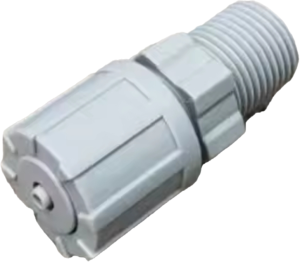
Chemical tubing should be:
- Chemical-compatible (typically PVC, PE, or Viton)
- Supported to avoid strain and vibration
- Replaced if brittle, discoloured, or cracked
Safety and Handling
Because dosing equipment handles concentrated chemicals, appropriate safety controls are required as follows:
- Bunding and spill control to prevent environmental release
- PPE (gloves, goggles, apron) to prevent chemical burns and exposure
- Clear labelling & SDS on site to ensure safe handling and emergency response
- Ventilated chemical storage to prevent fume accumulation